 Image 1 of 1
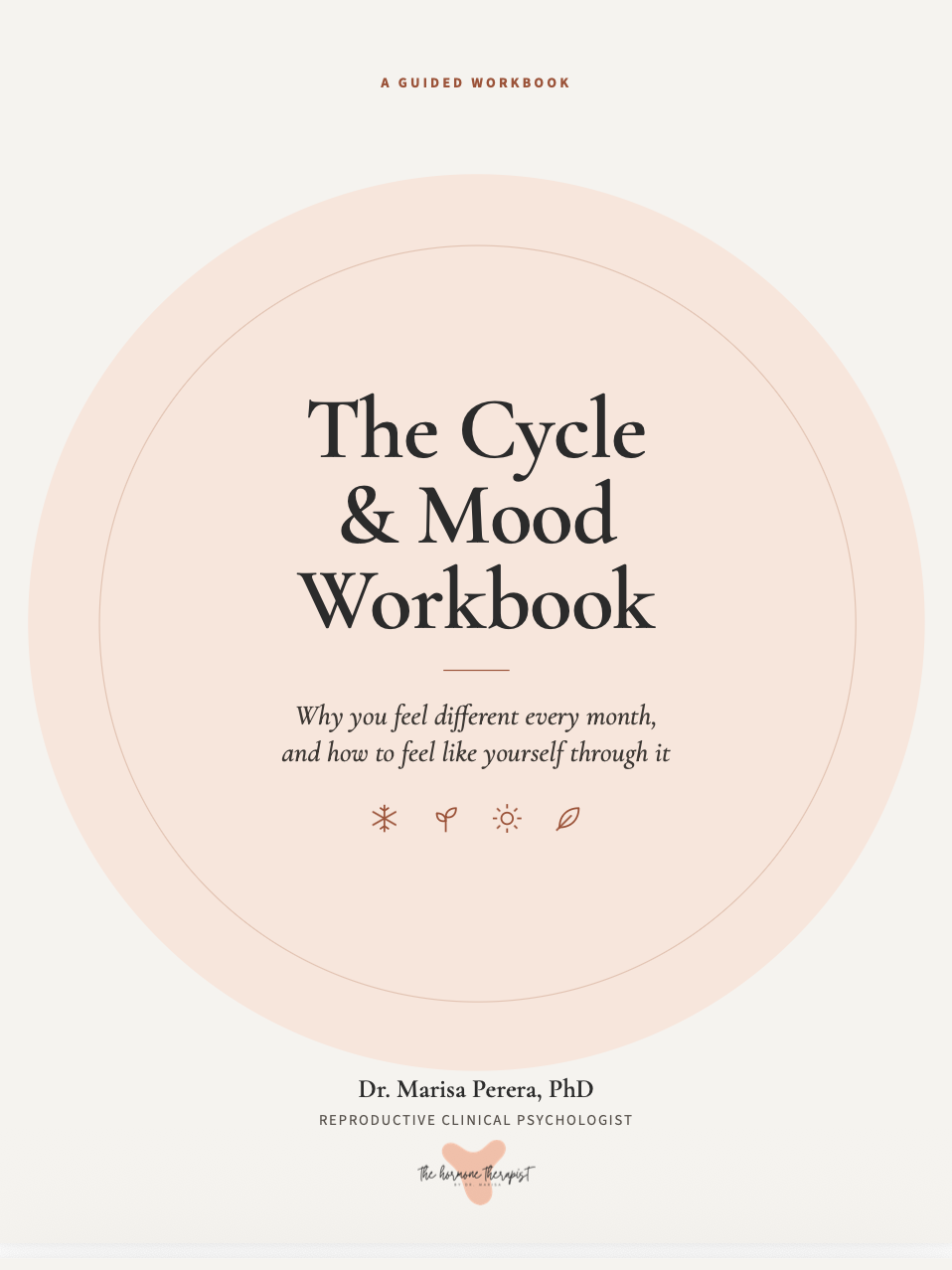
Cycle & Mood Workbook
Black Friday Sale on all Natal Resources!
The Cycle & Mood Workbook: Understand Your Mood Swings Before Your Period
Stop blaming yourself for what your cycle is doing. A guided workbook from a reproductive psychologist. About an hour. Yours to keep.
On day 12, you feel like yourself. Clear. Patient. Capable.
On day 25, you snap at someone you love, cry over nothing, and wonder what's wrong with you.
Then your period shows up.
That isn't a character flaw. It's a cycle. Mood swings, irritability, and anxiety before your period are often linked to how your hormones shift across the month. Nobody taught you that. So you've been blaming you for what your body is doing.
And that part, we can change.
A guided workbook for PMS, PMDD, and cycle-related mood changes
The Cycle & Mood Workbook is a self-paced, guided experience. It doesn't just teach you about hormones. It walks you, step by step, from "What's wrong with me?" to "Oh. This makes sense."
In about an hour, you'll:
Learn how your hormones affect your mood. See what estrogen and progesterone do across your menstrual cycle, and why the week before your period can feel so different.
Catch the self-blame. Notice the story you tell yourself on hard days, and find one that actually serves you.
Get tools for every phase of your cycle. Simple ways to care for your mind in your menstrual, follicular, ovulatory, and luteal phases.
Make a plan for your hardest week. Plus four questions to ask yourself when you don't feel like you.
Know when it might be PMDD or PME. A simple pattern check that shows when it's worth talking to a doctor, and what to say.
Go at your own pace. Print it, or fill it in on a tablet.
What early readers said
"Thank you for the permission that slowing down isn't laziness."
"This experience gives me agency."
"I got tangible action items."
"The analogies helped me understand it."
Created by a reproductive psychologist
I'm Dr. Marisa Perera, PhD, a reproductive clinical psychologist and founder of Natal Counseling. I earned a PhD at the University of Miami specifically in psychology where the body and mind connect, and completed a Women's Reproductive Mental Health Fellowship at Rush University Medical Center in Chicago.
For over a decade, I've sat with women who were never told what's normal for their bodies. Some lived for years with endometriosis or PMOS before anyone listened. Almost all of us were only ever told "PMS."
Most of them didn't have a character problem. They had a physiology problem that nobody explained.
Therapy helps, but it reaches one person at a time. So I made the guide I wish every woman, myself included, had been handed at 13.
What's inside the workbook
A 19-page guided workbook in five short parts
The Hormone Forecast: a simple picture of your menstrual cycle and mood
Rewrite the Story: six steps to swap self-blame for a truer story
Care for Your Mind: tools for each of your four inner seasons
Your Season Plan and pattern check: so you know when to get support for PMS, PMDD, or PME
Frequently asked questions
Why do I feel so different before my period?
In the luteal phase, the week or two before your period, progesterone rises and then drops along with estrogen. Some people are more sensitive to these shifts, which can bring irritability, anxiety, low mood, or brain fog. The workbook explains this in plain language and helps you see your own pattern.
Is it PMS or PMDD?
PMS is common and usually mild. PMDD (premenstrual dysphoric disorder) is more severe and gets in the way of work, relationships, or how you see yourself. PME (premenstrual exacerbation) is when an ongoing mood or anxiety concern gets worse before your period. The workbook can't diagnose you, but it helps you see when your pattern is worth a closer look with a provider.
Can I use it on birth control or with irregular cycles?
Yes. If you're on birth control, have irregular cycles, or don't have a regular period, you can still use it. The workbook shows you how to track by date so you can compare later.
Is this therapy?
No. It's education and guided reflection. If your symptoms are severe, or you're struggling most of the month, please reach out to a provider. The workbook will help you know what to bring.
How long does it take?
About an hour in total. You can do it in one sitting, or one part at a time.
You don't have to keep guessing
Take a breath. Notice what it might feel like to understand your hard days, instead of bracing for them.
That's what this is for.
Instant download. PDF, printable or tablet-friendly.
For broad educational purposes only. Not medical or mental health care, and does not create a therapist–client relationship.